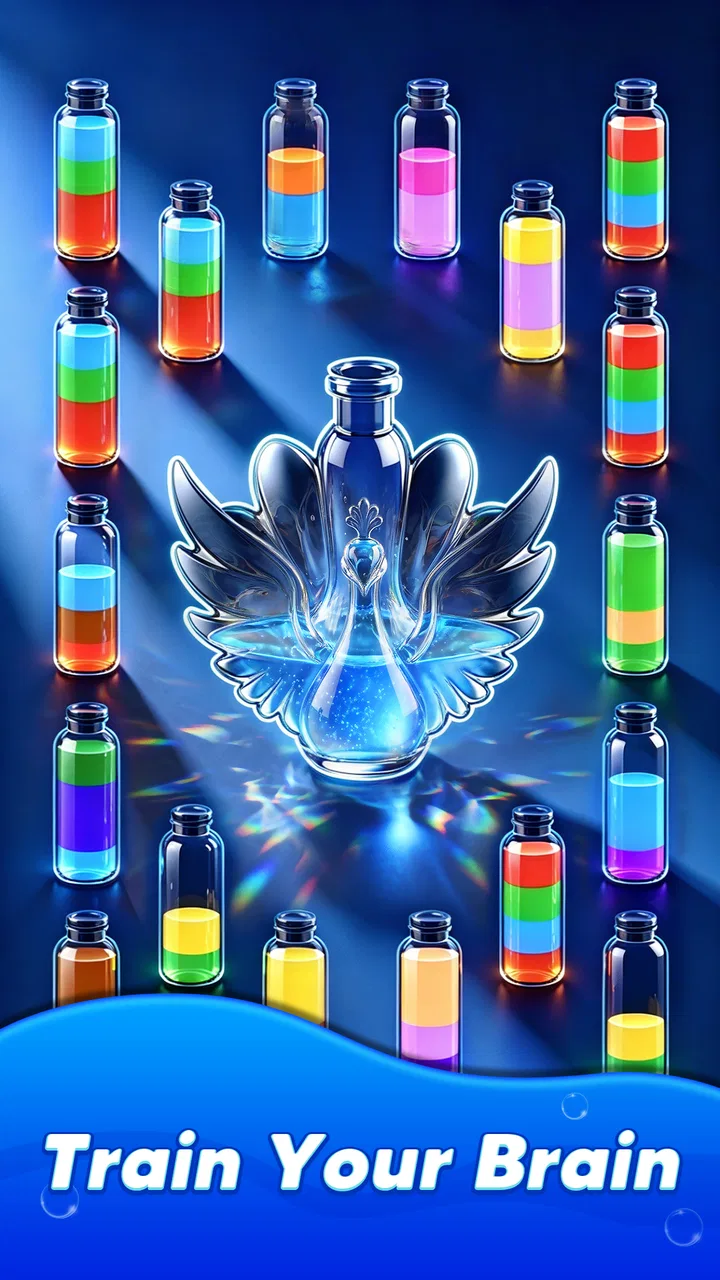
Water Sort: Master Colors
- 4.9
- Rating
- 1.00M
- Installs
- Free
- Price

 Analysis by App-foxy
I found Water Sort: Master Colors easy to understand within seconds and surprisingly difficult to put down after a few rounds. It is a free puzzle game from Bobodoo Game built around arranging colored liquid in bottles until each bottle contains a single color. That familiar idea is presented with creative bottle designs, but the real appeal is the quiet decision-making: every pour changes the shape of the puzzle, and one careless move can turn a simple board into a problem that needs careful recovery.
My first impression was positive because it does not ask me to learn a complicated rule set before playing. I can pick it up during a short break, make progress without needing sound, and stop after a level without losing the feeling that I accomplished something. At the same time, its simplicity means the game has to earn its place over time. The question is not whether the first few sessions are enjoyable; it is whether sorting colored water remains satisfying once the novelty of the bottles and the basic mechanic has faded.
Why the first week feels so approachable
The opening experience works because the central action is immediately readable. I tap a bottle, choose another bottle, and watch the liquid move when the rules allow it. There is no need to memorize a long tutorial or understand a story before the puzzle becomes playable. For someone who wants a casual sorting puzzle rather than an action game, that directness is a strong advantage.
You May Also Like

 Blood Strike: 2.5 Anniversary
Blood Strike’s Loadouts Turn Every Drop Into a Tactical Gamble
A close look at Blood Strike’s custom loadouts: how fast access to signature weapons reshapes its battle royale rhythm, rewards preparation, and narrows the gap between fights.

 Pandora - Music & Podcasts
Pandora’s Music Is Easy to Start, but Harder to Recover
Pandora’s strength is its low-effort path from a seed to a station. Its weak spot is how much confidence it asks you to place in connection, setup, and quiet recovery.

 8 Ball Pool
 Is Built on Rivalries, Rematches, and Routine
A close look at the rivalries, rematches, shared routines, and unanswered safety questions that turn a quick pool match into a persistent mobile community.

 Samsung Music
’s Quiet Strength Is Playing What You Already Own
Its reach comes less from spectacle than from dependable access to a personal library. That simplicity is both the app’s strongest retention engine and its ceiling.

 AccuWeather: Weather Radar
AccuWeather Review: A Quick, Clear Forecast for Everyday Decisions
For everyday plans, the best forecast is the one you can understand quickly. AccuWeather makes rain timing, radar, and local conditions easy to act on, with a few trade-offs.

 Hill Climb Racing
Why Hill Climb Racing Still Turns Crashes Into One More Run
A tiny car, a bumpy hill and one more upgrade: Hill Climb Racing keeps resurfacing because its simple chaos makes every near-miss feel personal.
More From Our News Desk



What makes the mechanic more interesting than it first appears is the limited space. A bottle that looks useful may actually be the only temporary storage position available, so pouring into it too early can block a later move. I quickly learned to look beyond the color I wanted to place and consider which bottle would remain available afterward. That small change in thinking turns each level from simple matching into a sequence-planning exercise.
During the first week, I would use it in situations where a larger game would feel excessive: waiting for an appointment, taking a short break from work, or winding down before bed. The game suits those moments because the mental demand is focused but not overwhelming. I can play actively for a few minutes, then put the phone away without needing to remember a complicated objective or return to a real-time event.
The game’s Everyone age rating also makes its presentation broadly accessible. I would feel comfortable suggesting it to someone looking for a calm color-based puzzle, including a younger player who already understands basic touch controls. The important qualification is that accessibility of presentation does not mean every board stays easy. The challenge comes from planning, not from fast reactions.
The first-week appeal also comes from the sense of visible order. At the beginning of a puzzle, the bottles may look mixed and untidy. By the end, the board becomes organized one container at a time. I find that visual transformation more rewarding than a score alone because the result is easy to understand immediately. It gives the game a mild relaxing quality, even when I am concentrating hard on avoiding a dead end.
One practical habit improved my results: I stopped treating an empty bottle as a place to pour whenever it was available. Instead, I reserve it as a flexible workspace and try to keep at least one route open for the color that is buried underneath another layer. This is not a flashy technique, but it prevents many self-created problems. Players who approach every move as “put matching colors together now” may find the game more frustrating than players who think a few moves ahead.
Another useful approach is to identify the most restricted color before making the first move. If a color is trapped beneath several different layers, it deserves attention even if it is not the easiest color to complete. Clearing access to that layer can matter more than finishing a convenient pair. This makes the game a little more strategic and gives experienced players a way to improve without needing a separate explanation of advanced rules.
The rating shown for the game is a 4.9 average from around 22 thousand ratings, and its reach has passed one million installs. Those figures suggest that the basic formula connects with a large audience, but they do not replace personal testing. In my experience, the appeal is strongest for people who enjoy orderly, low-pressure puzzles and weakest for anyone who needs constant variety, narrative, or fast feedback.
Small decisions that make early levels more enjoyable
I recommend resisting the urge to restart at the first sign of an awkward position. A difficult-looking board can often be repaired by using a temporary bottle to expose a hidden layer, then returning to the original plan. Restarting is useful when the position is genuinely blocked, but using it automatically removes the chance to learn why a move failed.
I also found it helpful to pause before every pour once the board becomes crowded. The game is not testing reflexes, so rushing provides no real benefit. Looking at the top visible layer of every bottle, rather than focusing only on the color I want, makes future options easier to see. This is one of the reasons the game works well as a short concentration exercise: it rewards attention without demanding speed.
For a new player, the best expectation is not that every level will feel relaxing. Some boards produce a satisfying flow, while others require deliberate backtracking and patience. That variation is healthy during the first sessions, because it stops the mechanic from becoming completely automatic. However, it also hints at the long-term question: once I have learned the basic planning habits, does the game continue to offer enough reason to return?
What remains useful after the novelty fades
After the first month, the value of a game like this depends less on discovery and more on routine. I am no longer impressed simply because the liquid moves neatly between bottles. I return when I want a predictable mental reset, a few minutes of focused attention, or a puzzle that does not require a large time commitment. That makes the game useful as a small daily habit rather than as something I need to play continuously.
The strongest recurring use case is the transition between activities. I can play one or two puzzles after finishing a task, during a commute when it is safe to do so, or before switching off for the night. The game gives my attention a clear target, which can be preferable to opening a social feed and losing track of time. It is especially suitable for players who like a calm activity that still asks them to make decisions.
Its long-term appeal is also helped by the fact that the mechanic remains understandable. I do not need to relearn controls after a break. If I leave it untouched for several days, I can return and begin immediately. That low memory burden is valuable in a casual game, because many mobile titles lose me when returning requires catching up on events, energy systems, or complicated objectives.
Still, the same consistency can become repetition. The central task remains sorting colors in bottles, so anyone hoping for a major change of genre or a developing story will eventually feel the limits. The creative bottle presentation can keep the boards visually pleasant, but decoration alone cannot create a new kind of challenge. For me, the game earns repeat visits when I want the specific sorting experience, not because it replaces every other puzzle on my phone.
The game is free to play, with in-app purchase items ranging from $1.99 to $69.99. That matters when judging lasting value. I would start without spending anything and first decide whether the regular puzzle loop remains useful in my routine. A free entry point makes that trial easy, but the presence of paid items means I would pay attention before confirming a purchase, especially if I was only looking for a lightweight time-filler.
The current version is 1.0.11, and the game runs on Android 7.0 or later. For someone using an older compatible phone, that broad system requirement is practical. It also means the game may be a reasonable option for a spare device rather than a title that demands recent hardware. I would still judge the experience on the individual phone, since comfort depends on screen size, touch response, and how easily the bottle colors can be distinguished.
How it compares with other casual puzzle choices
Compared with match-three games, this one is slower and more deliberate. There is no need to scan for a rapid chain of matches or react before the board changes. I prefer Water Sort: Master Colors when I want control over each move and dislike the pressure of timed turns. A match-three alternative is better when I want brighter bursts of feedback, faster sessions, or more obvious momentum.
Compared with word puzzles, the game depends less on language. That makes it a better fit for someone who wants a visually based challenge or who does not want to think about spelling. Word games are usually stronger for vocabulary practice and variety of subject matter, while this game is stronger as a quiet spatial exercise. The choice comes down to whether I want to organize containers or work with meanings and letters.
Compared with number-based logic games, the bottle format is more tactile and easier to read at a glance. Number puzzles may offer deeper calculation or more formal deduction, but they can also feel like work when I am tired. Here, the rules are concrete: colors occupy layers, bottles have limited room, and every pour has a visible consequence. That clarity is a strength, although players seeking complex mathematical reasoning may find it too gentle.
There is also a difference between this game and puzzle titles built around a campaign or story. Those alternatives can provide a stronger reason to continue because characters, locations, or plot developments change the context. Bobodoo Game’s title is more self-contained. Its recurring value comes from the act of solving, so it is best for people who enjoy the process itself rather than needing an external reward to maintain interest.
The maintenance burden of keeping it in a routine
Maintenance is relatively light because the game does not require a complicated personal system. I do not need to schedule long sessions or prepare anything before playing. The only habit that makes a real difference is learning to slow down when the board becomes crowded. Once I treat each empty bottle as a strategic resource, the puzzles feel less like trial and error.
There is, however, a mental maintenance cost. If I play too many similar boards in one sitting, I start making careless moves because the visual pattern feels familiar. The best way to avoid that fatigue is to stop after a satisfying puzzle rather than continuing simply because another level is available. This is a game I enjoy more in small portions than in a long marathon.
I would also keep an eye on purchase prompts and spending boundaries. The game is free, but the available in-app items make it sensible to decide in advance whether I am willing to buy anything. For a child’s device, I would use the phone’s normal purchase protections and discuss that choice beforehand. That is not a criticism of the sorting mechanic; it is simply part of using any free mobile game responsibly.
Color recognition is another practical consideration. Because the puzzle depends on distinguishing liquid colors, a player with difficulty telling similar shades apart may find some boards less comfortable than expected. A larger screen or higher brightness could help, but I would not choose this as my main puzzle game if color separation is already a recurring problem in other apps.
The age rating of Everyone supports broad use, but the game is not automatically ideal for every age group. A child may enjoy the visual sorting, while an older player may appreciate the planning exercise. On the other hand, someone looking for educational explanations, detailed progress feedback, or a structured learning path should choose a purpose-built educational puzzle instead. This game is primarily for play and concentration, not formal instruction.
Where the routine starts to feel tiring
The main source of fatigue is repetition in the core action. Even when the arrangement changes, the basic rhythm of selecting a bottle and transferring a color remains familiar. I notice this most when I play while distracted: the game is easy to start, but the next puzzle does not always feel meaningfully different from the previous one.
Another source of frustration is the gap between a clever mistake and a careless mistake. When I choose the wrong temporary container after thinking through the options, the failure can feel instructive. When I tap too quickly or overlook a visible layer, the result feels avoidable rather than challenging. The game rewards patience, but that also means it can expose my own lack of attention in a way that is not always relaxing.
Players who dislike restarting may find blocked positions especially discouraging. A puzzle can appear close to completion and still require an earlier move to be undone. That is part of the logic of the format, but it is not equally enjoyable for everyone. If I want a puzzle where every mistake can be corrected smoothly without revisiting the sequence, another design may suit me better.
The game is also not the right choice for someone who needs a strong sense of progression beyond solving boards. Its lasting value is modest and personal: it can become a reliable short break, but it is unlikely to become a major hobby for players who expect new systems, social competition, or a rich narrative. I would recommend it selectively rather than claiming it is a universal puzzle solution.
My most effective way to reduce fatigue is to alternate how I play. Sometimes I solve quickly by recognizing the safest available move. At other times, I deliberately map the visible layers first and plan a sequence before touching the screen. This keeps the same mechanic from feeling completely automatic and turns familiar boards into a small exercise in improving accuracy.
My long-term verdict
After the initial novelty fades, Water Sort: Master Colors still earns a place on my phone, but only in the right role. I see it as a dependable short-session puzzle rather than a game I would play for hours every day. Its strongest qualities are immediate accessibility, clear visual feedback, low commitment, and a planning loop that becomes more satisfying when I stop rushing.
I would recommend it to a friend who enjoys organizing things, prefers calm puzzles, and wants something that can be opened without preparation. It is also a good option for someone who wants a language-light alternative to word games or a slower choice than match-three titles. The free price makes it easy to test, while the broad age rating and Android 7.0 minimum make it approachable for many players.
I would be more cautious with a friend who needs constant novelty, dislikes repeating a single mechanic, or becomes irritated by having to undo a sequence after one poor decision. That player may get more lasting value from a puzzle game with varied modes, a campaign, or stronger narrative progression. Similarly, anyone uncomfortable distinguishing colors should consider whether the bottle presentation will remain readable in everyday use.
The paid items, from $1.99 to $69.99 each, are the main reason I would not describe the game as completely frictionless. I can enjoy the basic experience without spending, but I would keep purchases deliberate and avoid treating them as part of the normal cost of every short session. The game’s real value is in the solving loop, so spending only makes sense if it addresses a specific need and fits my own budget.
In the end, the game succeeds because it does not overcomplicate a simple idea. Bobodoo Game gives the familiar water-sorting format enough visual character to invite a first session, then relies on planning to support repeat play. It will not erase the limitations of a focused puzzle mechanic, and I would not expect it to replace every other game in this category. But as a small, repeatable way to reset my attention, it has enough lasting value to stay installed when I use it intentionally.
The best test is straightforward: play it for several short sessions instead of one long burst. If you enjoy protecting empty bottles, exposing buried colors, and correcting your own plans, the game can become a useful part of a casual routine. If the sorting rhythm already feels repetitive after that trial, the high rating will not change the underlying fit. For me, it remains a good free puzzle for focused breaks, with its long-term place determined more by my habits than by novelty.
FAQs for Water Sort: Master Colors
01What is the main objective of Water Sort: Master Colors?
Water Sort: Master Colors is a puzzle game where the main objective is to sort colored water in glass tubes until each tube contains only one color. Players must strategize their moves to carefully pour the water from one tube to another, ensuring no mix-ups occur. It's a challenging yet relaxing game that tests your problem-solving skills.
02Is Water Sort: Master Colors suitable for all age groups?
Yes, Water Sort: Master Colors is designed to be family-friendly and is suitable for players of all ages. Its intuitive interface and progressively challenging levels make it accessible for children, while still providing enough complexity to engage adults. It's a great way to improve cognitive skills and enjoy some leisure time.
03Does Water Sort: Master Colors require an internet connection to play?
No, Water Sort: Master Colors does not require an internet connection, making it a perfect choice for offline gaming. You can enjoy its puzzles anytime and anywhere, whether you're on a long flight or in a remote location. However, some features such as updates or in-app purchases may require connectivity.
04Are there any in-app purchases in Water Sort: Master Colors?
Yes, Water Sort: Master Colors offers in-app purchases. While the game is free to download and play, players have the option to buy hints, remove ads, or unlock additional levels or features. These purchases are optional and are designed to enhance the gaming experience, but are not necessary to enjoy the core gameplay.
05What features make Water Sort: Master Colors unique compared to other puzzle games?
Water Sort: Master Colors stands out with its visually appealing graphics, soothing sound effects, and a vast array of levels that increase in difficulty. The game offers a tranquil ambiance, encouraging players to engage in thoughtful problem-solving. Its user-friendly design and the ability to play offline further enhance its appeal among puzzle enthusiasts.
Pros
- Intuitive interface for easy gameplay.
- Challenging puzzles to engage your mind.
- Relaxing sound effects enhance focus.
- Offline play available for convenience.
- Regular updates with new levels.
Cons
- Ads can be intrusive at times.
- Limited hints without in-app purchases.
- Repetitive levels may bore some users.
- Graphics are basic
- lacking flair.
- No multiplayer or social features.

Water Sort: Master Colors
Gallery